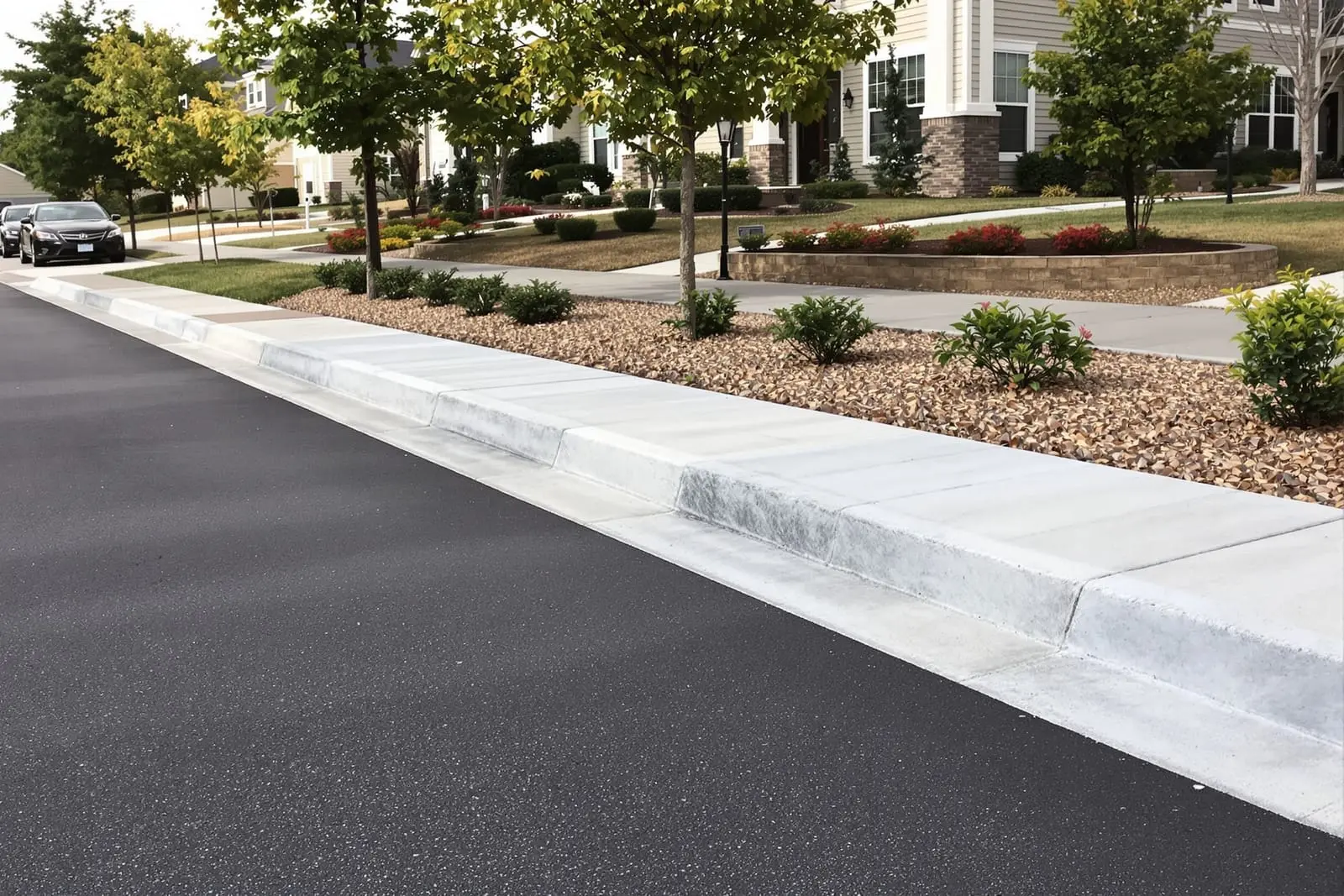
Direct traffic and water with concrete curb and gutter work in Augusta, GA. We form and pour curbs that define parking lots, drives, and roadway edges. Concrete barriers and medians add safety and separation so your site stays organized and drains correctly during storms.
Vanguard Concrete Augusta provides professional concrete curb and gutter throughout Augusta, GA and the surrounding area. Our licensed, insured crew delivers safe, clean, on-time work with a free estimate before anything begins. Call (762) 320-5837 or request your free quote.
Concrete Curb and Gutter Services in Augusta, GA
Curbs, gutters, and concrete barriers do a quiet but critical job on properties across Augusta. They control stormwater, protect pavement edges, guide vehicle movement, and keep pedestrians safer. Vanguard Concrete Augusta installs and repairs concrete curb and gutter systems that are tailored to our hills, red clay soils, and intense summer storms.
We work on residential driveways and subdivision streets, older properties near downtown and Summerville, as well as newer commercial sites in West Augusta, Martinez, and Grovetown. Whether you need a short run of curb along a driveway, full curb and gutter for a private road, or protective concrete barriers for loading areas, we design each project around how water really moves on your site and how vehicles actually use the space.
Our goal is simple: give you a concrete curb and gutter system that drains correctly, stands up to traffic and weather, and looks like it belongs with the rest of the property, not like an afterthought.
How We Install Concrete Curbs, Gutters, and Barriers
Our installation process is hands-on and site-specific, not one-size-fits-all. We begin with a site walk to shoot elevations, check existing drainage paths, and note structures, trees, and utilities. In Augusta it is common to find shallow utility lines near older streets, so we locate and mark anything that might conflict with excavation.
Once the layout is marked, we saw cut existing asphalt or concrete if we are tying into a driveway or parking lot. Then we excavate a trench to the depth needed for the curb and gutter, usually 8 to 12 inches below finished grade depending on traffic load. We shape and compact the subgrade so there are no soft spots that could let the curb settle or crack.
For most projects we install a compacted crushed stone base under the curb and gutter. On heavier use drives or commercial lots, we may add reinforcing steel bars or wire mesh in the curb, the gutter, or both. Forms are set to the correct line and grade, including a precise gutter slope so water flows all the way to the nearest catch basin or daylight outlet rather than ponding.
We pour concrete with a mix designed for curbs and gutters, usually in the 3,000 to 4,000 psi range, taking into account freeze-thaw cycles, traffic, and exposure to deicing salts near public roads. While the concrete is still workable, we tool the curb profile, form the gutter pan, and cut control joints at regular intervals to manage cracking. After finishing, we cure the concrete using a curing compound or wet curing method so it gains strength correctly.
Concrete barriers are installed on a similar base, but with more focus on impact resistance and anchoring. Depending on design, we may drill and epoxy rebar dowels into existing slabs or footings, then tie them into the new barrier pour for greater stability.
Design Options for Curbs, Gutters, and Concrete Barriers
Concrete curb and gutter does not have to be generic. Vanguard Concrete Augusta offers several profile and finish options so function and appearance work together on your property.
For residential driveways and neighborhood streets, we often install standard vertical curb with an integral gutter, or a roll-over curb that lets cars enter more comfortably while still controlling water. Roll-over and mountable curbs work well in subdivisions around Evans and Grovetown where multiple driveway cuts are common. In tighter older areas closer to downtown Augusta, steeper vertical curbs can help keep vehicles where they belong on narrow streets.
We can match existing curb styles, or upgrade to a more substantial section if you are dealing with repeated tire damage or erosion. Edge treatments can be simple tool-finished, broom finished for better traction, or lightly exposed aggregate in select areas for a more decorative look that still drains correctly.
Concrete barriers can be cast-in-place walls, wheel stops, or custom-height traffic barriers that separate parking from pedestrian zones or protect building walls and loading docks. Height, thickness, and reinforcement can be adjusted for your specific use, for example forklift traffic in warehouses, or school drop-off loops where pedestrian safety is a priority. We also coordinate transitions from barriers to open curb and gutter so plows and sweeping equipment can work easily around them.
What Drives the Cost of Concrete Curb and Gutter in Augusta
Several specific factors affect the cost of concrete curb and gutter projects in the Augusta area, and understanding them can help you plan and budget more accurately.
Length and layout are the starting point. Straight, open runs of curb and gutter on a new gravel subgrade are the most cost-effective. Costs increase when there are many curves, tight radiuses at driveway aprons, or frequent grade changes that require extra forming time. Urban properties with limited access or where concrete must be wheelbarrowed or pumped also add to the labor portion of the job.
Existing conditions matter. Removing old broken curb, thick asphalt edges, or tree roots along the edge of a driveway or lot adds time and disposal fees. In areas with heavy clay and poor drainage, we may recommend a thicker base or underdrain to prevent frost heave and long-term settlement, which raises material costs but reduces future repair expenses.
Thickness, reinforcement, and concrete strength are another cost driver. Residential curb and gutter along a light-use driveway can often use a standard section. Commercial sites, truck routes, and apartment complexes with dumpster pads or bus traffic usually require heavier sections, higher-strength mixes, doweled joints, and more steel.
Finally, restoration and tie-in work can affect price. Matching older patterned sidewalks in Summerville, adjusting lawn grades, adding topsoil and seed, or tying into city or county storm structures all add scope. Vanguard Concrete Augusta is transparent about which items are optional upgrades and which are necessary to keep your curb and gutter performing as intended.
Common Curb, Gutter, and Barrier Problems We Fix Locally
Augusta properties tend to show a consistent set of curb and gutter issues because of our climate and soil. Recognizing these problems early can save you money and protect your pavement.
One of the most common issues is ponding water along the gutter line. This usually occurs when the original concrete curb and gutter was not set with a consistent slope, or when settlement has created low spots or birdbaths. We address this by saw cutting out the affected sections and re-pouring with corrected elevations, sometimes combining this with minor grading changes upstream so water flows smoothly.
Another frequent problem is broken or crumbled curb faces along older asphalt drives and small business parking lots. Repeated tire impact, trash trucks riding the edge, and tree root pressure can all cause localized failures. In these cases we remove damaged sections, cut back asphalt enough to form the new curb, and, when needed, upgrade to a slightly thicker curb or improved base to resist future damage.
For concrete barriers and wheel stops, we often see movement or displacement caused by inadequate anchoring. Instead of simply setting barriers on the surface, we typically pin or dowel them into the slab or footing. When we replace or re-anchor barriers, we also look at vehicle turning movements and parking patterns so we can adjust barrier locations and spacing to fit how the space is really being used.
Local Code, Drainage, and Permitting Considerations
Curb, gutter, and barrier work interacts closely with drainage rules and local standards in Richmond and Columbia counties. Vanguard Concrete Augusta keeps these requirements in view from initial layout to final inspection so your project does not end up with surprises.
For private residential work, like driveway-side curb and small gutter runs, formal permits are not always required, but drainage still matters. If changes in curb height or direction send water toward a house foundation, neighbor, or sidewalk, you can end up with erosion, basement moisture, or runoff disputes. We design slopes and curb openings so water continues to discharge where it is allowed, and we coordinate with any existing yard drains, swales, or city inlets.
On larger commercial and multifamily properties, curb and gutter lines usually tie into engineered stormwater plans. In those cases we follow the grading plan, curb types, and inlet structures specified by your engineer. If field conditions, like unexpected utility lines or poor soils, make the original plan unworkable, we document the issue and propose practical adjustments, such as slightly altering gutter slope or shifting inlets, then coordinate approval.
Curbs and barriers that interact with public streets, driveways, or ADA-accessible routes must meet local transportation and accessibility standards. That can include specific curb ramp slopes, detectable warning surfaces, and minimum curb heights where sidewalks abut traffic. We are familiar with typical city and county details in the Augusta area and build to those standards so inspectors can sign off promptly.
What to Know Before You Hire a Concrete Curb and Gutter Contractor
Before you bring in a contractor for concrete curb and gutter or barrier work, it helps to know what to ask and how to compare proposals.
Ask how the contractor will determine gutter slope and elevations. A reliable company will mention using a level, laser, or transit, not just eyeballing it. They should be able to explain where the water will go after it enters the gutter and how the new work will interact with your existing drainage.
Request clarity about base preparation, thickness, concrete strength, and reinforcement. Your quote should specify at least approximate curb and gutter dimensions, type of base material and depth, and psi rating of the concrete mix. This is especially important for drive lanes that see delivery trucks or garbage trucks.
Discuss access, traffic control, and downtime. For small residential driveways, we typically schedule so you are only without access for a limited time, then give you a clear schedule for curing and when you can drive on the new curb and gutter. For active businesses and churches, we can phase the work or shift schedules to keep part of your lot open.
Finally, ask about warranty and realistic maintenance expectations. Properly installed concrete curb and gutter in our climate should last many years with only minor cracking. We explain what is normal and what is not, and what to watch for, such as early signs of settlement or repeated ponding after storms. Vanguard Concrete Augusta is based in the community we serve, so we plan to be here for follow-up questions long after the trucks pull away.
“
Professional curbs, gutters & concrete barriers, done right the first time, quality materials, honest pricing, and results that last.
Vanguard Concrete Augusta
Curbs, Gutters & Concrete Barriers Across Our Service Area