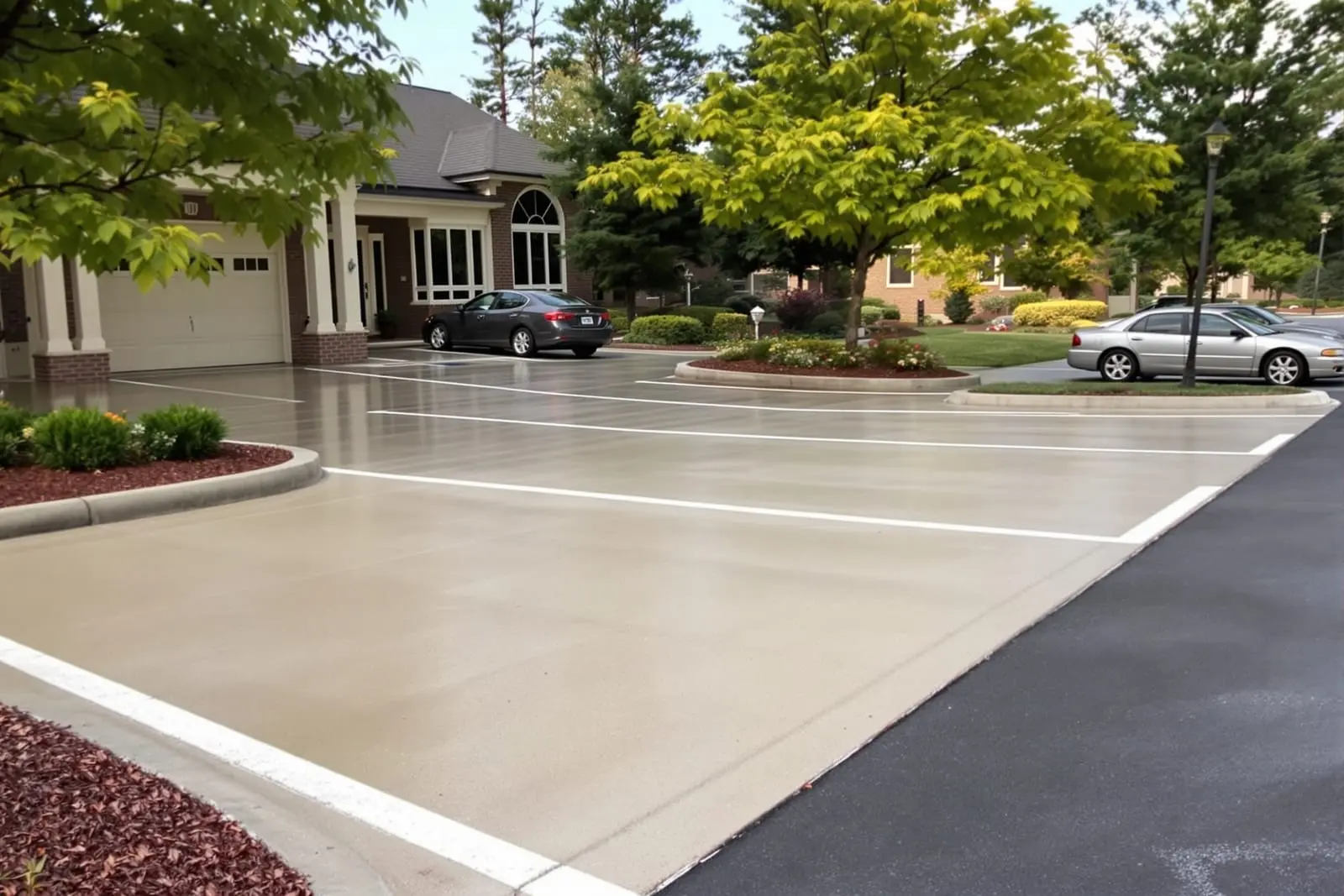
Invest in a long lasting concrete parking lot in Augusta, GA for your property. We design and pour parking areas with proper thickness, reinforcement, and drainage. Striping, curbs, and accessible spaces are integrated so your lot is safe, organized, and ready for customer traffic.
Vanguard Concrete Augusta provides professional concrete parking lot throughout Augusta, GA and the surrounding area. Our licensed, insured crew delivers safe, clean, on-time work with a free estimate before anything begins. Call (762) 320-5837 or request your free quote.
Concrete parking lots built for Augusta traffic and heat
A concrete parking lot is more than a flat gray surface. For businesses in Augusta, it is a working piece of infrastructure that has to handle heavy vehicles, sudden storms, and long stretches of 90-degree heat. Vanguard Concrete Augusta designs and installs parking lots that match your traffic load, drainage needs, and local site conditions, not a generic national template.
We start by discussing how your parking lot is actually used. Do you have delivery trucks every day, or mostly passenger cars? Is there a dumpster pad that sees repeated heavy loads from garbage trucks? Do you have steep drive entries off Washington Road or a flatter lot off Peach Orchard Road? These details decide slab thickness, reinforcement type, and joint layout.
Our team also considers the way Augusta’s clay soils swell and shrink with moisture. A design that might survive in a dry climate will fail quickly over plastic red clay. We adjust base thickness, compaction targets, and dowel placement so your concrete parking lot stays level and avoids early cracking.
Vanguard Concrete Augusta does not push concrete where asphalt would be better for a specific use, and we do not undersize sections to win bids. We show you the options, explain the service life expectations, and build a parking lot that fits your site instead of a one-size-fits-all plan.
Our concrete parking lot installation process
A durable parking lot starts with the work you cannot see. Vanguard Concrete Augusta begins with layout and excavation. We strip vegetation, remove soft or organics-laced soil, and cut the parking area to the design grade. On many Augusta sites we find pockets of loose fill or old construction debris. These areas are dug out and replaced, not just rolled over.
Next is the base. For most commercial concrete parking lots we install a graded aggregate base, typically a compacted crushed stone mix. This layer is brought up in lifts, each compacted to a specified density. On sites with poor drainage or known soft spots, we may use thicker stone or a geotextile fabric to separate the stone from the clay beneath.
Formwork defines the edges and any concrete islands. We set forms to the final elevation, allowing for slope toward catch basins or swales so rainwater moves off the surface instead of forming ponds. In Augusta, sudden thunderstorms can dump water fast, so we aim for practical slopes that move water while staying comfortable for pedestrians.
Reinforcement, like welded wire fabric or rebar, is placed where the design calls for it, often at drive lanes and truck routes. Then we pour a properly proportioned ready-mix concrete, typically 4000 psi or higher, with air entrainment to handle minor freeze-thaw cycles. The mix, slump, and additives are selected for the day’s temperature and humidity so we do not get plastic shrinkage cracking or weak surfaces.
We strike off the concrete, bull float it, cut control joints at the right spacing, and finish it with a broom texture to provide traction in wet conditions. Curing is not an afterthought. We apply a curing compound or use wet curing methods so the slab gains strength evenly. Finally, we sawcut joints where needed, clean the lot, and schedule striping after the concrete reaches the right cure age.
Design choices that affect performance and cost
Not every concrete parking lot needs the same thickness or reinforcement. Vanguard Concrete Augusta looks at your traffic patterns, soil conditions, and budget to set the right combination without cutting corners that matter.
Slab thickness is one of the biggest cost drivers. A small professional office with only cars might need 4 to 5 inches of concrete. A restaurant that sees frequent box trucks or a retail center with semi deliveries usually needs 6 inches or more in drive aisles and loading zones. Dumpster pads and fire lanes often go thicker still. We show you where heavier sections are needed and where we can keep thickness down to control cost.
Reinforcement can be simple welded wire fabric in many areas, while high demand zones may use #4 or #5 rebar in a grid pattern. For highly loaded or problematic soils, we may suggest doweled expansion joints and thicker aggregate base instead of relying only on steel. We explain what each option actually does so you can make a realistic decision.
Surface finish and slope are also design choices. A light broom finish provides traction and does not glare in bright sun. Slope is typically set between 1 and 2 percent so water drains without making walking difficult. In Augusta, where short intense storms are common, it is important to move water toward inlets and away from entrances so customers do not step into standing water.
Color or decorative bands are optional but possible. Some property owners request colored concrete for crosswalks or entry areas to guide traffic and highlight pedestrian paths. Others prefer standard gray for easier maintenance. We can also integrate thicker concrete under planned car stops and along curb edges where vehicles repeatedly load the slab.
How Augusta weather and soils affect your parking lot
Local climate matters a great deal for concrete parking lots. Augusta summers bring high heat and direct sun, which drive surface temperatures up and increase evaporation. If the mix, timing, and curing are not managed, this can cause early shrinkage cracking or weakened surfaces. Vanguard Concrete Augusta schedules pours to avoid the hottest part of the day when possible and adjusts mix designs for warm-weather placement.
Thunderstorms and Gulf moisture mean sudden, heavy rain is always a possibility. A flat parking lot is asking for trouble in this environment. Poor grading or inadequate inlets will leave water standing on the surface, which can seep into joints and edges and soften the supporting soil. Over time, this leads to edge cracking and settlement. We design your concrete parking lot with defined drainage paths and coordinate with your site engineer or plumber so catch basins and slopes line up.
Augusta’s red clay and mixed fill soils can expand and contract with moisture changes. If the subgrade is not prepared correctly, you can see differential settlement, where one section sinks and another stays put. We test and proof-roll the subgrade to locate soft areas and correct them before placing stone. On known problem sites, we may recommend lime treatment, thicker aggregate base, or both to stabilize the subgrade.
Although Augusta does not see long deep freezes, we do get enough cold snaps that non air-entrained, over-saturated concrete can scale or spall at the surface over time. That is why we use air-entrained mixes for exterior flatwork and pay attention to joint sealing and drainage around the perimeter.
Common concrete parking lot problems and how we prevent them
Most parking lot failures follow a pattern. Vanguard Concrete Augusta designs and builds with those failure modes in mind so you avoid repeat repairs.
Random cracking is usually a sign of poor joint layout, wrong joint depth, or fast drying. We plan a joint pattern that matches the shape of your lot and expected cracking planes, cut joints to the correct depth, and manage curing so the concrete shrinks in a controlled way instead of pulling itself apart.
Surface scaling or raveling often comes from finishing too early, adding water on the surface, or using the wrong mix in hot conditions. Our crews do not sprinkle water to retemper the surface. We control slump at the truck, finish at the right time, and use a consistent broom finish so the top layer is strong enough for daily traffic and seasonal temperature swings.
Settling and broken edges are typically tied to poor base or subgrade. That is why we spend time on excavation, compaction, and stone thickness, especially along drive entrances where vehicles turn and load the edges. We also consider doweled joints and thicker edges where design calls for it.
Drainage-related problems, like ponding or water entering buildings, come from slope errors and poor coordination with site drainage. We check slopes with laser levels, run simple flow checks, and coordinate with other contractors so inlets are set at the right heights and in the right locations.
For existing lots that already have issues, we offer assessment and phased repair plans. Sometimes full replacement is not required. In other cases, partial-depth repairs or overlays would only delay an inevitable failure. We explain what is realistically worth your money instead of selling a quick fix that will not last.
Planning, timelines, and working around your business
Replacing or building a concrete parking lot affects how your customers reach the door. Vanguard Concrete Augusta plans projects to minimize disruption and be transparent about how long each phase will take.
A typical new concrete parking lot, depending on size, takes several days for excavation and base work, 1 to 3 days of concrete placing, and about a week before opening to normal traffic. Light foot traffic is often allowed sooner, but we protect the slab from vehicle loads until it has reached enough strength. In warm Augusta temperatures, initial strength gain is faster, but we still follow conservative timelines so you are not risking early damage.
For businesses that cannot shut down, like medical offices or retail stores, we often phase the work. We break the lot into sections so part remains open while we reconstruct the other. This may involve temporary signage, cones, and coordination with delivery schedules. We communicate changes in access points ahead of time so you can inform your staff and customers.
Permitting and inspections vary by jurisdiction in the Augusta area. In Richmond and Columbia counties, you may need site plan approval and inspections tied to the overall development. We assist with plan details related to the concrete work, such as thickness specs, reinforcement notes, and joint layouts, so your engineer and code officials have clear information.
Before you hire any contractor for a concrete parking lot, ask for project references, mix designs, and joint layouts for past jobs of similar size. Ask how they handle Augusta’s heat and storm patterns, and how they plan to manage business access during construction. Vanguard Concrete Augusta is prepared to answer these questions in detail and provide local examples so you can see what you are getting before the first yard of concrete is ordered.
“
Professional parking lot concrete, done right the first time, quality materials, honest pricing, and results that last.