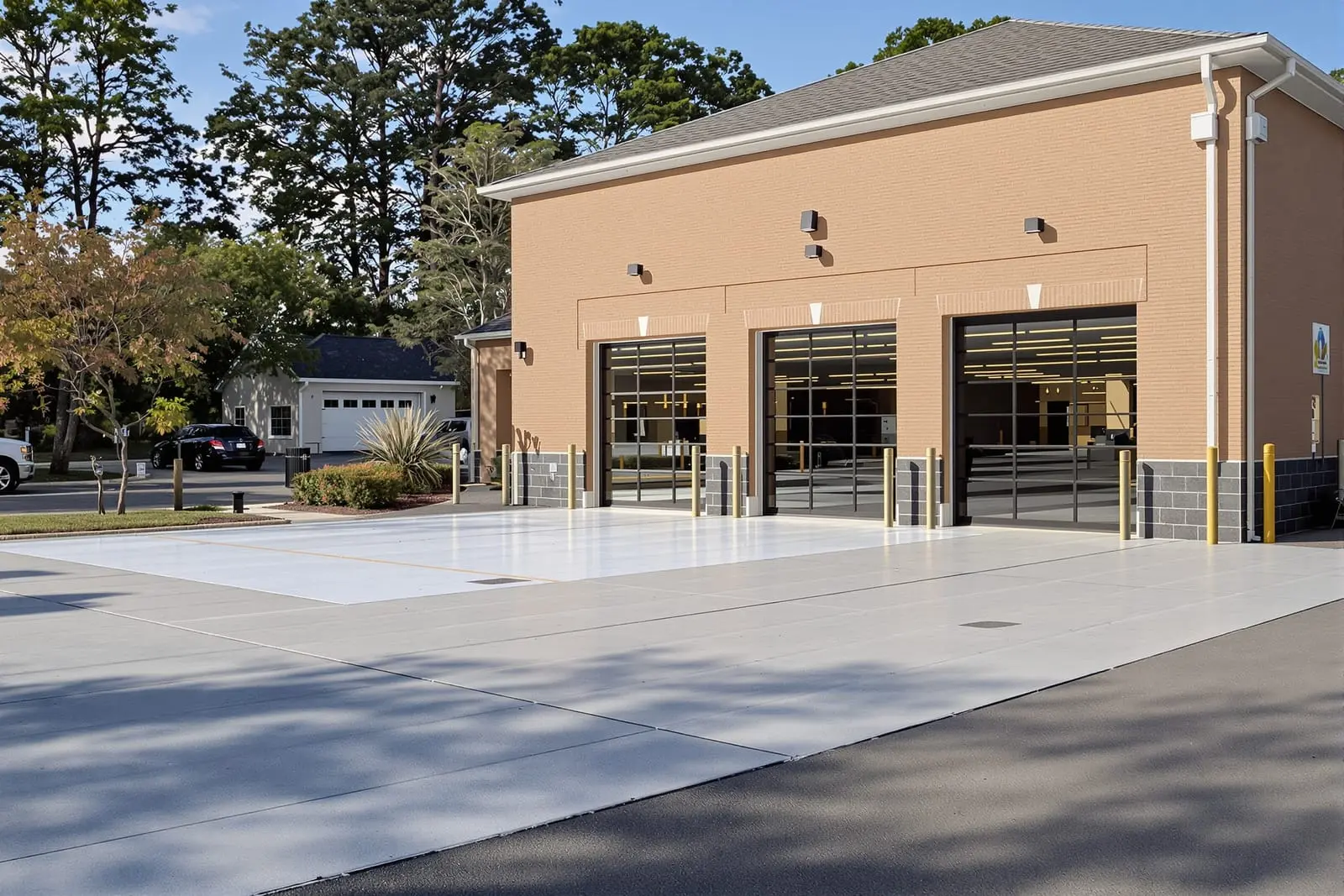
Support shipping and operations with a heavy duty commercial concrete slab in Augusta, GA. We pour reinforced slabs for loading docks, equipment pads, and work areas. Thickness, joints, and reinforcement are matched to your loads so slabs resist cracking and settlement over time.
Vanguard Concrete Augusta provides professional commercial concrete slab throughout Augusta, GA and the surrounding area. Our licensed, insured crew delivers safe, clean, on-time work with a free estimate before anything begins. Call (762) 320-5837 or request your free quote.
Commercial Concrete Slabs Built For Augusta Workloads
When you pour a commercial concrete slab in Augusta, you are building the surface that will carry your entire operation. Vanguard Concrete Augusta focuses on the details that keep slabs and loading docks flat, safe, and functional under real-world traffic, not just on paper specs.
For warehouses, distribution centers, retail pads, and light industrial spaces, we start by looking at how the slab will be used. Forklift routes, pallet rack locations, dock positions, and door openings all matter. We use this information to determine slab thickness, joint layout, reinforcement type, and where to place thickened sections. A typical commercial concrete slab may range from 4 inches for light retail use up to 8 inches or more in high traffic, heavy rack, or dock zones.
In the Augusta area, clay-heavy soils and variable fill are common. Before any forming or rebar goes in, we evaluate the existing subgrade, moisture levels, and drainage. If needed, we call for undercutting soft pockets and replacing them with compacted crusher run or graded aggregate base, not just rolling the surface and hoping for the best. This is the difference between a slab that stays flat and one that starts cracking and settling within a couple of years.
Vanguard Concrete Augusta coordinates with your architect or engineer when plans already exist, or we help you establish practical design criteria when you only have an idea and a building footprint. Our goal is straightforward: a commercial concrete slab that handles your loads, drains correctly, and gives you a reliable working surface from day one.
Loading Dock Design That Matches Your Equipment And Traffic
Loading docks are more than a raised edge and a roll-up door. If the deck height, approach slope, or reinforcement is wrong, you get hard hits on trailer bumpers, broken dock plates, and chipped concrete at the lip. Vanguard Concrete Augusta designs and pours loading docks based on your actual trucks, equipment, and site constraints.
We verify dock height against the trailer fleet you use most often, whether that is standard 48 to 53 foot over-the-road trailers, box trucks, or a mix. The transition ramp, both inside and outside, is laid out for your forklift and pallet jack traffic, with slopes that equipment can handle safely in wet or dusty conditions. Inside the building, we often thicken the slab at the dock face or install additional reinforcement to handle impact from forklifts entering and exiting trailers.
Dock faces and truck aprons are poured with higher strength concrete and tighter joint spacing because this area takes concentrated wheel loads and repeated impact. We plan for dock levelers, edge of dock plates, and bumper installations before the forms are set. That means getting embeds, angles, and anchor positions right during layout, rather than drilling into finished concrete and weakening the edge later.
Augusta’s hot summers and occasional cold snaps mean expansion and contraction cycles that matter at exposed dock edges. We use proper joint sealants, adequate curing, and correct reinforcement details so the dock face does not spall, chip, or separate from the adjacent pavement as temperatures shift.
How We Build A Commercial Concrete Slab That Stays Flat
The process for a commercial concrete slab or loading dock starts long before the trucks show up with ready-mix. Vanguard Concrete Augusta breaks the work into disciplined steps so the slab you get matches the design and performs under traffic.
1) Site prep and subgrade. We strip organics and soft material, then proof-roll the area. Any pumping or deflection under the roller is corrected with undercut and replacement, not ignored. We typically install 4 to 8 inches of compacted granular base and ensure positive drainage away from the building line and dock.
2) Vapor barrier and insulation (where required). For conditioned spaces, refrigerated storage, or moisture-sensitive operations, we place a true vapor barrier, not just a thin plastic sheet. Seams are taped, penetrations are sealed, and the barrier stays intact when reinforcement is set.
3) Formwork and layout. We set forms to laser elevations and check diagonals so the slab is square. At loading docks, we form dock faces, curbs, wheel stops, and trenches for drains or conduits where specified. This also includes setting blockouts for dock levelers or pit-style equipment.
4) Reinforcement. Depending on load and design, we install rebar mats, dowels at construction joints, or structural mesh. For heavy rack areas or dock approaches, we often use rebar on chairs with tighter spacing to control cracking under repeated wheel loads.
5) Concrete placement and finishing. We order a mix suited to Augusta’s climate and your schedule, typically a 4,000 to 5,000 psi commercial mix with proper air content. Placement is done with laser screeds or straightedges for flatness, then finished to the specified texture, such as a hard trowel interior finish or broom finish on exterior docks and aprons.
6) Curing and jointing. Proper curing is essential in our hot, often dry summers. We apply curing compounds or use wet cure where specified, then cut control joints at the right spacing and depth to manage shrinkage cracking. For large projects needing flatness numbers (FF/FL), we schedule cuts and curing with that performance target in mind.
What Drives Cost For Loading Docks And Commercial Slabs
Commercial concrete slab pricing in Augusta is driven by more than just square footage. Vanguard Concrete Augusta walks customers through the key cost factors before work begins so you can set a realistic budget and avoid surprises.
Thickness and reinforcement. Heavier loads, higher rack systems, and dock traffic naturally require thicker slabs and more steel. Moving from 4 inches with light mesh to 6 or 8 inches with rebar on a tight grid significantly affects both material and labor costs, but it also dramatically increases slab performance and lifespan.
Subgrade corrections. If your site has poor fill, soft spots, or existing pavement that has to be removed, that work has a direct impact on cost. We provide clear options, such as limited undercut targeting only bad zones or full-depth replacement where necessary. Fixing subgrade problems during construction is cheaper than dealing with differential settlement or structural slab repair after you are operating.
Loading dock complexity. A simple straight dock face with bumpers and a basic apron costs less than multiple recessed docks with leveler pits, trench drains, and integrated curbs. Features like heated thresholds, thickened edge beams, or specialty coatings for chemical exposure add to cost but may be critical in certain industries.
Schedule and access. Tight schedules, night or weekend work, and limited truck access can affect labor and pumping requirements. We look at your operations, neighboring businesses, and local traffic patterns in Augusta to schedule pours when concrete delivery will be reliable and curing conditions are acceptable.
We prefer to separate “must have” structural items from “nice to have” upgrades when we quote. That way you understand what is essential for safety and performance, and where there is flexibility to adjust scope to meet your budget.
Common Slab And Dock Problems In Augusta And How We Prevent Them
Local conditions around Augusta lead to a predictable set of problems when commercial slabs and loading docks are not designed or built correctly. Vanguard Concrete Augusta focuses on preventing these issues rather than selling repair work later.
Settlement along dock faces. Poor compaction under the truck apron or lack of proper base can lead to the asphalt or concrete outside the dock settling away from the face. We combat this by using suitable base materials, compacted in lifts, and by tying the dock slab into adjacent pavement with dowels where appropriate.
Random cracking and curling. Many slabs crack because joint spacing or depth is wrong, or because curing is neglected. In our climate, rapid moisture loss is a constant risk. We manage this with correct joint layout, prompt saw cutting, and curing methods that match the season. When slab thickness changes, such as at dock edges or thickened slabs under racks, we detail reinforcement to minimize curling.
Surface wear and spalling. High traffic paths in warehouses and at dock thresholds can polish, dust, or chip if the concrete mix or finishing is not appropriate. We use mixes with correct aggregate hardness, avoid adding surface water during finishing, and can specify hardened surfaces or sealers in areas with intense forklift traffic.
Drainage problems. Water that runs back toward the building or sits at the dock edge leads to slippery conditions and freeze-thaw damage in colder snaps. We design slopes in the slab and apron to move water away, and we incorporate trench or area drains where necessary. For existing sites, we evaluate how new slabs will connect to current grading so we do not create unwanted low spots or ponding.
Working With Vanguard Concrete Augusta On Your Project
Commercial concrete work goes smoother when the contractor, owner, and design team are aligned early. Vanguard Concrete Augusta prefers to get involved when layouts are still flexible so we can flag issues that often get missed on paper but cause real problems in the field.
On new construction, we coordinate with your general contractor, steel erector, and site contractor to sequence work efficiently. That may mean pouring interior slabs after the building is framed to reduce weather risk, or tackling exterior dock and apron work while utility trenches are still open. For expansions and retrofits, we plan around your operating hours so you have as little downtime as possible at active docks.
We handle permitting requirements tied to concrete work within city of Augusta and Richmond County guidelines, such as runoff controls, sidewalk tie-ins, and accessible route considerations near dock and entry slabs. When engineering is needed, we can work with your chosen engineer or help connect you with local professionals familiar with Augusta soils and codes.
Before pricing, we typically perform a site visit. We look at truck circulation paths, neighboring properties, existing grades, and soil conditions. You get a clear, written scope that calls out slab thickness, reinforcement, joint layout approach, and any special details at docks, equipment pads, or transitions to asphalt and gravel.
If you are planning new loading docks or a commercial concrete slab in the Augusta area, Vanguard Concrete Augusta can help you move from a sketch or concept to a constructed surface that handles real traffic and real weather without constant patching.
“
Professional loading docks & commercial slabs, done right the first time, quality materials, honest pricing, and results that last.
Vanguard Concrete Augusta
Loading Docks & Commercial Slabs Across Our Service Area